New World Screwworm is a parasitic fly whose larva invade wounds and body openings of animals and humans. They can cause extensive damage to livestock.
Current Situation
Animals: The first case of NWS in U.S. livestock was found in Texas on June 3, 2026, followed by other cases in Texas and New Mexico.
Humans: No locally acquired infestations in humans in the United States have been reported as of June 2026.
The risk of NWS infestation in people within the United States remains low and is currently limited to areas where NWS flies are present. Federal agencies, including the CDC, USDA, and Department of the Interior, are working closely with state, local and tribal partners to monitor the situation and prevent further spread among people and animals.
Latest Information
Eradication Efforts
The United States successfully eradicated New World screwworm in 1966 using the Sterile Insect Technique (SIT), one of the most successful pest control programs in history. This effort is being renewed to control screwworm currently in the U.S.
Information, Reporting and Guidance
About New World Screwworm
- The New World screwworm (NWS) is a parasitic fly whose larvae (maggots) feed on the living tissue of warm-blooded animals.
- When larvae from the fly get into a wound or opening in the body, they cause myiasis, or an infestation of fly larvae. Unlike typical maggots that feed on dead tissue, screwworm larvae invade healthy tissue, causing severe wounds with their sharp mouth hooks, infection, and possibly death if untreated.
- NWS infestations are treated by having the larvae removed by a veterinarian (in animals) or healthcare professional (in humans).
- Screwworms primarily affect livestock, but can also infest pets, wildlife, and rarely humans. Screwworm infestation in cattle can lead to the animal's death and can damage the ranching and agricultural industries.
Screwworms are spread by screwworm flies, the movement of infested animals, and travelers returning from areas affected by New World screwworm. They do not spread directly from person to person or animal to person.
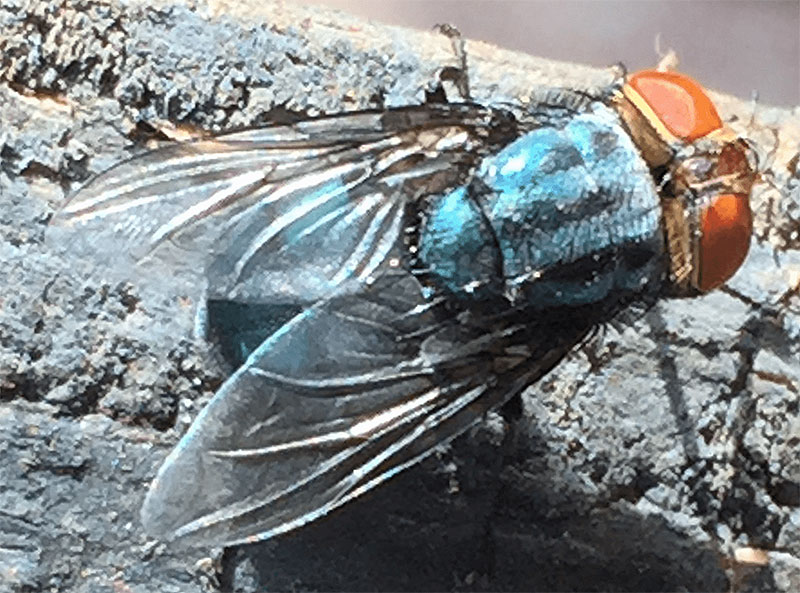
The adult New World Screwworm fly has large orange eyes, a yellow face, and blue body with three stripes along the back.
(Photo: USDA)

Screwworm larva
(Photo:CDC)

Screwworm larva showing mouth hooks that embed into animal tissue.
(Photo: John Kucharski, USDA)
Symptoms
In Animals
- Non-healing or worsening wounds
- Visible maggots in living tissue
- Foul-smelling discharge
- Swelling, bleeding, or tissue damage
- Behavioral changes such as restlessness, irritation, or reduced feeding
In Humans (rare)
- Painful or worsening skin lesions
- Sensation of movement in a wound, sore, ears, nose, eyes, or mouth
- Seeing larvae around or in open sores
- Drainage or bleeding from wounds
- Foul smelling odor from the site of the infestation
- Possible fever or secondary infection.
Guidance for Specific Groups
General
- Clean and cover all wounds immediately.
- Seek medical care for wounds that worsen or do not heal.
- Larvae should not be thrown in the trash or outside while they are alive. Kill larvae by immersing them in isopropyl alcohol.
Guidance for:
Travelers
- Wear protective clothing in at-risk areas.
- Use an EPA registered insect repellent.
- Treat clothing and gear with products containing 0.5% permethrin (an insecticide/repellent).
- Keep open wounds clean and covered.
- Sleep indoors or in screened shelters.
- Monitor any wounds carefully after travel.
Veterinarians
- Inspect wounds carefully in animals.
- Report suspected cases immediately to the Mississippi Board of Animal Health. See Reporting
Wildlife professionals and hunters
- Inspect animals for unusual wounds.
- Inspect harvested animals carefully.
- Report abnormal wounds or infestations to the Mississippi Department Wildlife, Fisheries and Parks at 601-432-2400.
Farmers and ranchers
- Inspect animals regularly for wounds.
- Treat injuries immediately.
- Maintain fly control practices.
- Report suspicious cases quickly to your veterinarian and the Mississippi Board of Animal Health. See Reporting
Pet owners
- Check pets regularly for wounds.
- Keep injuries clean and protected.
- Seek veterinary care promptly.
Healthcare providers
- Consider travel history in wound cases.
- Remove larvae and treat infection.
- Any larvae collected for identification should be submerged in 70% alcohol (ethanol or isopropanol) in a plastic container with a screw cap that can be tightly sealed.
- Report suspected cases to the Mississippi State Department of Health at 601-576-7725
Reporting Cases of NWS
Cases in Livestock
Report suspected cases to a veterinarian and to the Mississippi Board of Animal Health: msstatevet@mdac.ms.gov or 1-888-646-8731.
Cases in Wildlife
Report abnormal wounds or infestations to the Mississippi Department of Wildlife, Fisheries and Parks at 601-432-2400.
Cases in Humans
Report suspected cases to the Mississippi State Department of Health at 601-576-7725.
Healthcare providers: Arrange screwworm sample submission with MSDH by providing your information and photos with the link below.
For Veterinarians
Coordinate with Mississippi Board of Animal Health:
- By phone during office hours: 601-359-1170
- By phone after hours: 1-888-646-8731
- By e-mail: msstatevet@mdac.ms.gov
Quesions and Answers
Can I get NWS from an animal or from someone who is infested?
No, you cannot directly catch NWS myasis (infestation) from an infested animal or person. However, adult flies can lay eggs on and infest different people living in the same space.What should I do if I think I have an NWS infestation?
If you think you may have an NWS infestation, keep your wound covered and see your health care provider as soon as possible. NWS larvae can burrow deep into wounds, so you can hurt yourself if you try to remove the larvae on your own. Your health care provider will be able to safely remove the larvae. Do not throw live larvae in the trash or outside while they are alive. Larvae can be killed with isopropyl (rubbing) alcohol.What should I do if I think my pet or livestock has an NWS infestation?
Animals with an NWS infestation typically display:- Irritation or discomfort
- A smell of death or decay around a wound or orifice
- Open wounds or sores
- Wounds where larvae are visible
If you see or suspect any of these symptoms, contact your veterinarian so the animal can be assessed quickly.
If your pet or livestock is diagnosed with NWS infestation, you or your vet should contact the Mississippi Board of Animal Health.
How do I submit a specimen for identification or testing?
For human cases, the Office of Epidemiology will coordinate with health care providers for specimen identification or testing through the CDC. Please use our submission form to provide information about MSDH. Specimens will not be accepted from the general public.
For livestock or wildlife cases, see our reporting section above.
Any larvae collected for identification should be submerged in 70% alcohol (ethanol or isopropanol) in a plastic container with a screw cap that can be tightly sealed.
How did the U.S. eradicate the New World screwworm previously?
An eradication program to remove the screwworm from the United States was started in 1957 using sterilized flies developed by USDA's Agricultural Research Service. The sterile-insect approach eradicated the screwworm from the U.S. in 1966. Sterile flies are one of the most important tools we have for eradicating screwworm. The USDA is investing heavily in new and existing sterile fly infrastructure to ramp up production and expand our domestic response capacity. Learn moreResources
Mississippi Board of Animal Health
- New World Screwworm Information
- Information for Veterinarians PDF
- Brochure: New World Screwworm Essential Information PDF
USDA
- Stop ScrewwormInformation on the Screwworm Eradication Program
- Fact Sheet: New World Screwworm PDF
- Brochure: NWS (What You Need to Know) PDF
- Brochure (Spanish): NWS (What You Need to Know) PDF
- Poster: Screwworm Life Cycle and Identification PDF